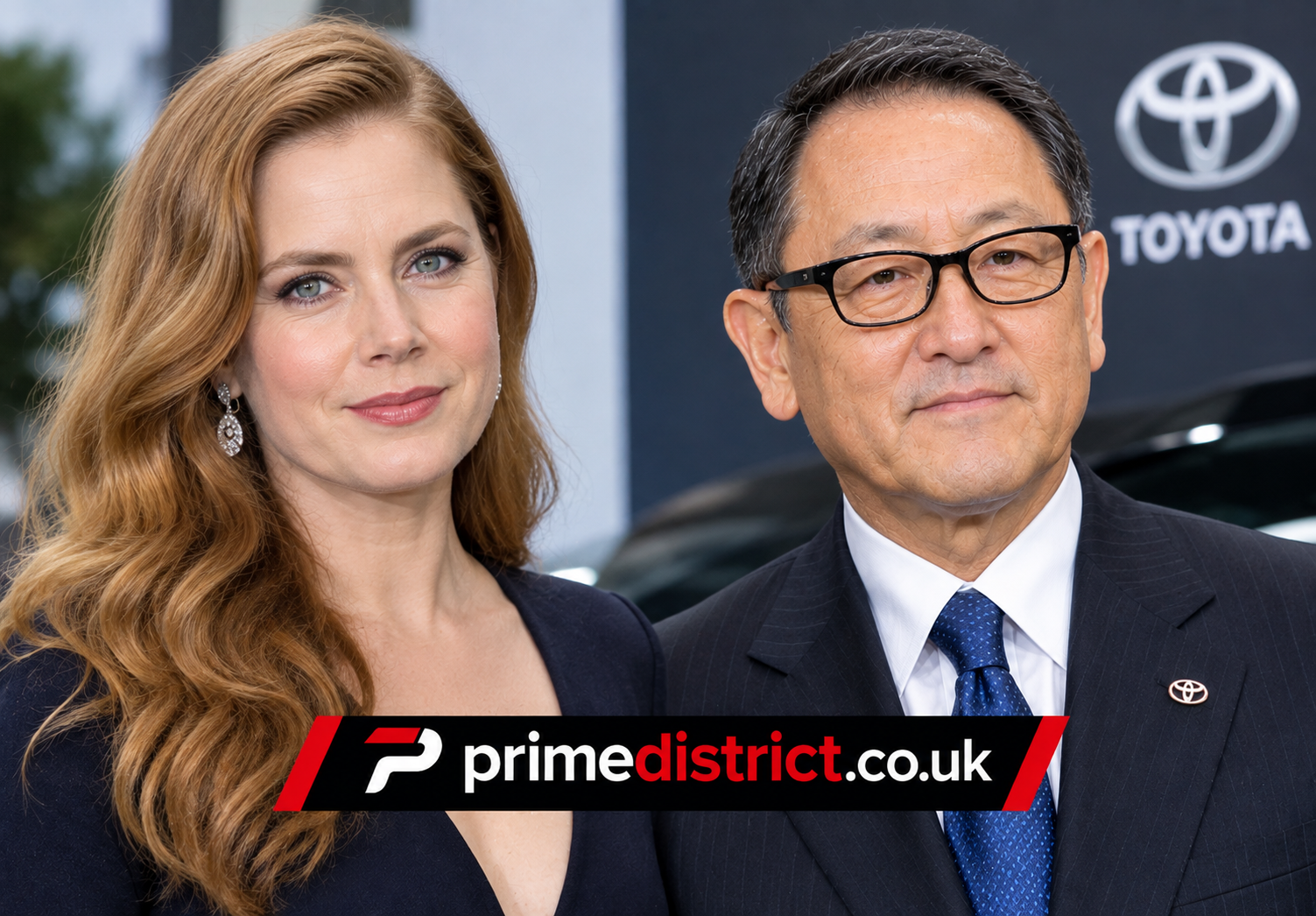
Amy Adams and Akio Toyoda come from dramatically different professional worlds. Adams is an acclaimed American actress recognized for performances across film and television, while Toyoda is a longtime Toyota executive who became chairman of Toyota Motor Corporation in 2023. Their careers do not represent a direct partnership, but examining them side by side offers an interesting perspective on adaptability, consistency, leadership, and long-term performance. These same principles are increasingly important in modern cloud architecture, where scalable systems must balance innovation, reliability, security, and cost.
Who Is Amy Adams?
Amy Adams is an American actress whose career has included acclaimed dramatic performances, major commercial productions, television projects, and musical roles. She has appeared in films including Enchanted, Arrival, American Hustle, Julie & Julia, Big Eyes, and Nightbitch, as well as the television miniseries Sharp Objects. Her career demonstrates an ability to move between very different genres and character types.
That versatility provides a useful analogy for technology organizations. Modern businesses rarely operate in one environment forever. Customer expectations change, applications evolve, and organizations move between traditional infrastructure, hybrid environments, and cloud platforms.
A scalable architecture therefore needs flexibility. Instead of building an application around a single rigid infrastructure model, architects can use modular services, APIs, containers, and managed cloud resources that allow individual components to evolve independently.
Who Is Akio Toyoda?
Akio Toyoda has spent much of his professional life within Toyota. He joined Toyota Motor Corporation in 1984, worked across areas including production, marketing, product development, and international operations, became president in 2009, and assumed the role of chairman in April 2023. Toyota’s current corporate information continues to identify him as chairman of the board.
His career is particularly relevant to discussions about operational discipline and large-scale systems. Toyota operates across global manufacturing, supply chains, mobility technologies, sales networks, and digital services. Such environments require coordination between many interconnected components.
Cloud architecture faces a similar challenge. A large enterprise application may involve databases, APIs, identity services, analytics platforms, storage systems, monitoring tools, and third-party integrations. If one component becomes unreliable, the impact can spread throughout the system.
What Amy Adams and Akio Toyoda Represent Differently
The most useful comparison is not that Adams and Toyoda have the same careers—they clearly do not. Instead, they illustrate two different approaches to professional performance.
| Area | Amy Adams | Akio Toyoda | Cloud Architecture Connection |
|---|---|---|---|
| Primary field | Film and television | Automotive and mobility | Industry-specific technology |
| Core challenge | Adapting to different roles | Managing complex global operations | Handling changing workloads |
| Key theme | Versatility | Operational consistency | Flexible but reliable systems |
| Scale | Individual productions and global audiences | Global corporate operations | Distributed cloud infrastructure |
| Technology relevance | Digital production and distribution | Connected mobility and enterprise systems | APIs, data, automation and cloud platforms |
| Long-term lesson | Adapt without losing quality | Scale without losing discipline | Build flexible, governed infrastructure |
This distinction is important. Strong cloud architecture does not simply mean adding more servers or services. It means designing an environment capable of changing without becoming unnecessarily complicated.
Lessons in Cloud Scalability
Scalability is one of the defining advantages of cloud computing. A traditional server environment may require an organization to purchase additional hardware before demand increases. Cloud platforms can instead provide mechanisms for dynamically increasing or decreasing resources.
Consider a streaming platform releasing a highly anticipated film. Traffic could remain moderate for weeks and then increase sharply when the title receives widespread attention. An elastic cloud architecture can respond by adding application capacity, distributing requests across multiple instances, and using caching to reduce pressure on backend services.
This principle resembles adaptability. Like an actor moving between different types of productions, a well-designed cloud system should handle changing requirements without requiring an entirely new foundation.
Horizontal scaling is particularly valuable. Rather than continually making one server larger, organizations can distribute workloads across multiple instances. Load balancers can distribute requests while autoscaling mechanisms adjust capacity according to demand.
Reliability and Operational Discipline
Scalability without reliability can create serious problems. An application capable of handling millions of requests is not useful if it frequently becomes unavailable.
Large enterprises therefore emphasize redundancy, monitoring, disaster recovery, and controlled operational processes. Cloud architects apply similar principles through multi-zone deployments, automated backups, health checks, failover mechanisms, and infrastructure-as-code.
For example, a critical application might operate across several availability zones. If one zone experiences an infrastructure problem, traffic can be redirected to healthy resources.
This approach also highlights an important architectural principle: failure should be expected rather than treated as impossible.
A resilient system assumes that servers, networks, databases, and external services can experience interruptions. Architecture is designed so that individual failures do not automatically become complete outages.
Security in Modern Cloud Environments
Security must be built into cloud architecture from the beginning rather than added at the end.
A secure enterprise environment typically uses identity and access management, encryption, network segmentation, centralized logging, vulnerability management, and continuous monitoring. Access should follow the principle of least privilege, meaning users and services receive only the permissions required for their responsibilities.
Consider a hypothetical media company managing confidential production material. Its cloud environment could separate development, testing, and production accounts. Sensitive storage could use encryption, while identity policies restrict access to authorized teams.
Similarly, large industrial organizations need strict controls around operational and business data. As connected vehicles, manufacturing systems, and digital platforms become more sophisticated, protecting information and infrastructure becomes increasingly important.
Cost Considerations and Cloud Efficiency
Cloud computing can reduce infrastructure investment, but cloud adoption does not automatically guarantee lower costs.
Organizations can overspend through unused virtual machines, excessive data transfer, oversized databases, unnecessary storage, or poorly managed development environments. Effective cloud architecture therefore combines technical performance with financial discipline.
A practical cost strategy begins with visibility. Teams should understand which applications consume computing, storage, networking, and database resources.
Architects can then use mechanisms such as autoscaling, scheduled shutdowns for non-production resources, appropriate storage tiers, reserved capacity where suitable, and serverless services for variable workloads.
For example, a website receiving unpredictable traffic may benefit from serverless computing because resources can scale according to demand. A continuously running enterprise workload may have a different economic profile and require a different architecture.
Practical Use Cases for Cloud Architecture
The principles discussed through Amy Adams and Akio Toyoda can be applied to several real-world scenarios.
A media company could use cloud content delivery networks to distribute videos and web content globally. Object storage could hold large media files, while serverless functions process metadata and automated workflows.
An automotive organization could use cloud platforms for connected-vehicle data, analytics, fleet monitoring, digital customer services, and software development. Data pipelines could collect information from distributed systems before processing it through analytics platforms.
Retail companies can similarly combine scalable application services, managed databases, recommendation engines, and real-time analytics to handle seasonal demand.
In each case, the architecture must balance performance, security, availability, and cost rather than optimizing only one dimension.
Challenges of Building Scalable Systems
Cloud architecture introduces flexibility, but it also creates complexity.
Distributed systems can be difficult to monitor because a single user request may pass through numerous services. Organizations must understand dependencies, latency, failure patterns, and data flows.
Another challenge is vendor dependence. Cloud providers offer powerful managed services, but organizations should understand portability requirements before building critical applications around proprietary technologies.
Data governance is another concern. Businesses must know where sensitive information is stored, who can access it, how long it is retained, and how it is protected.
Finally, technical debt can grow rapidly. Adding another service may solve an immediate problem but increase long-term operational complexity. Good architecture therefore favors simplicity where possible.
Future Trends: From Cloud Computing to Intelligent Mobility
Cloud architecture is continuing to evolve alongside artificial intelligence, edge computing, connected devices, automation, and real-time analytics.
Edge computing will become increasingly important for applications that require rapid responses. Instead of sending every piece of information to a centralized cloud region, selected processing can happen closer to the device generating the data.
Connected vehicles provide a strong example. Certain safety-related or latency-sensitive functions may require local processing, while broader analytics can be performed in cloud infrastructure.
The same architectural principle applies to media and entertainment. Content recommendation, audience analytics, digital production workflows, and global distribution can all depend on a combination of cloud and edge technologies.
The future is therefore unlikely to be defined by one technology alone. Successful organizations will combine cloud platforms, local computing, automation, analytics, and secure data management according to the requirements of each workload.
Why Adaptability Matters in Modern Technology
The careers of Amy Adams and Akio Toyoda demonstrate very different forms of professional adaptability. Adams has worked across genres and formats, while Toyoda’s career has involved multiple functions across a complex global automotive organization. Their paths should not be interpreted as evidence of a direct connection; rather, they provide two separate examples of how long-term careers can involve changing environments and responsibilities.
Cloud architecture requires a similar mindset. Organizations must prepare for changing traffic, evolving customer expectations, new security requirements, emerging technologies, and unexpected failures.
The strongest architecture is rarely the most complicated one. It is the architecture that provides sufficient flexibility while remaining understandable, secure, observable, and economically sustainable.
Frequently Asked Questions
1. Are Amy Adams and Akio Toyoda professionally connected?
There is no established professional connection between Amy Adams and Akio Toyoda. They are prominent figures in completely different fields: Adams in entertainment and Toyoda in the automotive industry.
2. What is Amy Adams best known for?
Amy Adams is known for a wide range of film and television performances, including Enchanted, Arrival, American Hustle, Julie & Julia, Big Eyes, and Sharp Objects. She has received multiple major award nominations and wins during her career.
3. What is Akio Toyoda’s current role?
As of 2026, Akio Toyoda is chairman of the board of directors and a representative director of Toyota Motor Corporation.
4. What does scalability mean in cloud computing?
Scalability is the ability of a technology system to handle changing workloads by increasing or decreasing available resources. Cloud environments can support this through autoscaling, load balancing, distributed infrastructure, and managed services.
5. Why are security and cost important in cloud architecture?
Security protects applications, users, and business information, while cost management prevents unnecessary infrastructure spending. A successful cloud architecture must balance performance, availability, security, scalability, and financial efficiency.
Conclusion
Amy Adams and Akio Toyoda represent two very different professional journeys, but examining their careers side by side can highlight broader ideas about adaptability, consistency, and long-term performance. Adams’ varied entertainment career illustrates the importance of adapting to changing roles, while Toyoda’s decades within Toyota demonstrate the complexity of operating and evolving a global organization.
Those ideas translate naturally into modern cloud architecture. Scalable systems must adapt to demand, resilient infrastructure must anticipate failure, security must be designed into the foundation, and cost must remain under control as environments grow.
For businesses preparing for the next generation of digital services, the objective is not simply to move applications into the cloud. It is to build technology foundations that can evolve with the organization. That combination of flexibility, discipline, security, and sustainable growth is what turns cloud infrastructure into a long-term business capability.