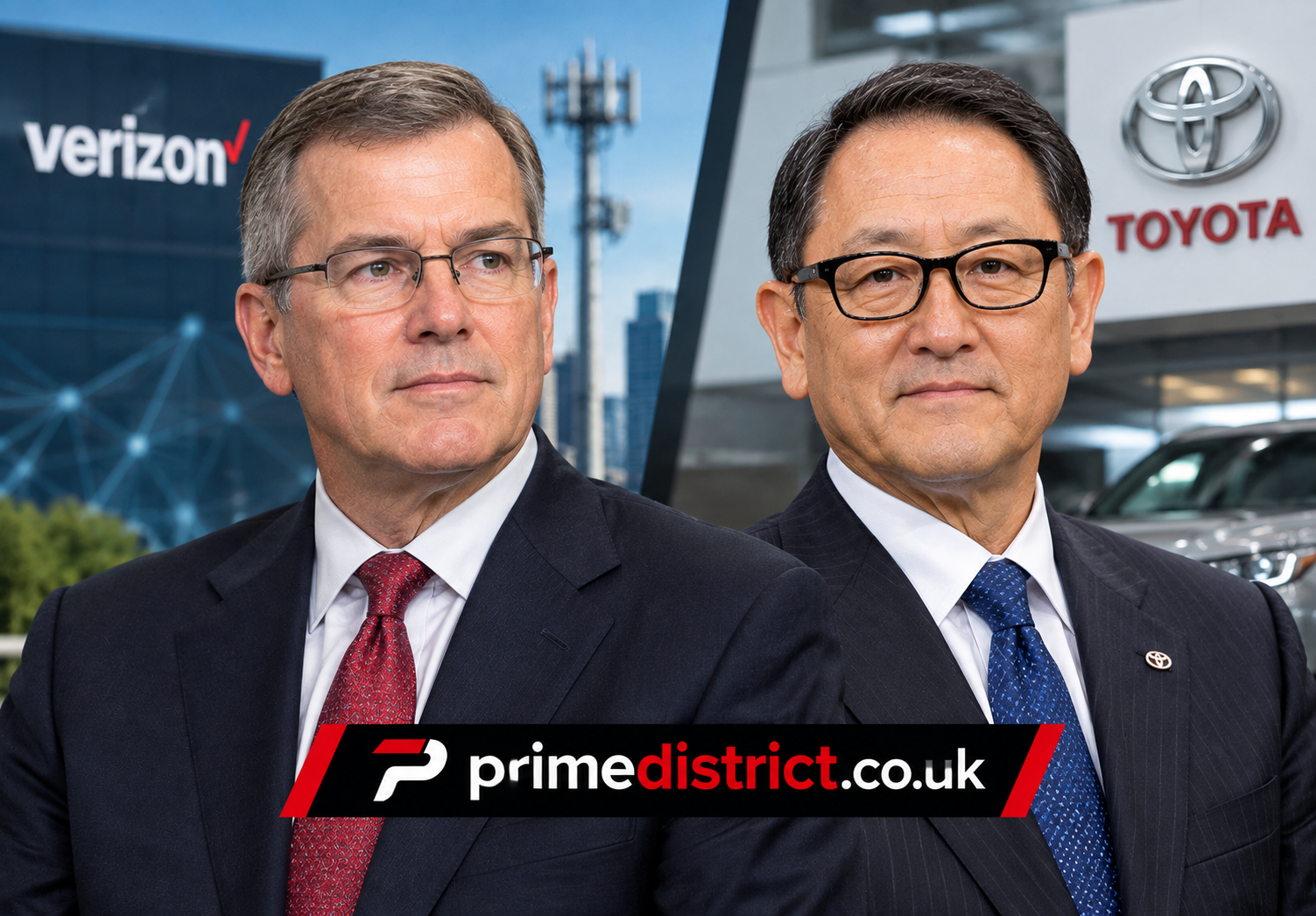
Lowell McAdam and Akio Toyoda built influential careers in two very different industries: telecommunications and automotive manufacturing. McAdam became known for his leadership at Verizon, while Toyoda spent decades developing Toyota’s global operations before becoming chairman. Their careers also reveal how traditional industries have increasingly depended on connectivity, digital platforms, cloud computing, data, and technology-driven customer experiences.
Who Are Lowell McAdam and Akio Toyoda?
Lowell McAdam is a former chairman and CEO of Verizon Communications. An engineer by education, McAdam developed much of his career in telecommunications, holding senior positions at companies including Pacific Bell, AirTouch Communications, PrimeCo Personal Communications, and Verizon. He became Verizon’s CEO in 2011 and chairman in 2012.
Akio Toyoda has spent most of his professional life at Toyota Motor Corporation. He joined Toyota in 1984 and worked across areas including production, marketing, product development, sales, operations, and information technology. He became Toyota’s president in 2009 and chairman in April 2023.
Although their industries are different, both careers demonstrate the importance of combining operational expertise with technological transformation.
Lowell McAdam’s Role in Telecommunications Transformation
McAdam’s career developed alongside the rapid evolution of wireless communications. Before becoming Verizon’s CEO, he served as president and CEO of Verizon Wireless and held operating responsibilities covering wireless and wireline businesses. His background also included responsibility for technology management and CIO functions.
This experience is particularly relevant to modern cloud architecture because telecommunications networks are fundamentally distributed technology platforms. They must support huge numbers of users, continuously process data, maintain availability, and scale infrastructure as demand changes.
For businesses, the lesson is straightforward: digital transformation is not simply about purchasing new software. It requires reliable infrastructure, strong data systems, security controls, operational monitoring, and an architecture capable of growing with demand.
Akio Toyoda and the Connected-Car Revolution
Akio Toyoda’s career illustrates how the automotive industry has moved beyond mechanical engineering toward software, connectivity, cloud services, and digital ecosystems.
Toyota’s work with Microsoft provides an early example. In 2011, Toyota announced plans to use Microsoft’s Windows Azure cloud platform for connected-car applications. Proposed capabilities included remotely monitoring vehicle information, managing charging, checking battery information, and connecting vehicles with energy-management systems.
This concept changed the traditional definition of a vehicle. Instead of operating as an isolated machine, a connected vehicle could communicate with cloud services, mobile devices, infrastructure, and other digital systems.
From a cloud architecture perspective, such an ecosystem can involve vehicle sensors, mobile applications, APIs, message-processing systems, databases, analytics platforms, identity services, and monitoring tools.
What Their Careers Have in Common
McAdam and Toyoda worked in different sectors, but both operated in industries where infrastructure and technology are critical.
| Area | Lowell McAdam | Akio Toyoda |
|---|---|---|
| Primary industry | Telecommunications | Automotive |
| Major organization | Verizon | Toyota |
| Leadership focus | Wireless, networks and digital services | Manufacturing, mobility and connected vehicles |
| Technology connection | Communications infrastructure | Connected-car and mobility technology |
| Cloud relevance | Distributed connectivity and digital platforms | Connected vehicles, data and cloud services |
| Global operations | International telecommunications experience | Extensive international automotive operations |
| Transformation challenge | Scaling communications networks | Digitizing mobility while maintaining manufacturing excellence |
The common thread is that technology becomes valuable when it supports a larger business strategy. A cloud platform, for example, has little value if an organization cannot connect it to customer needs, operational processes, security requirements, and measurable business outcomes.
Cloud Architecture Lessons From Telecommunications
Telecommunications offers useful lessons for designing scalable cloud systems. A modern communications environment must handle large and unpredictable volumes of traffic while maintaining availability.
The same principles apply to cloud applications. A scalable architecture might use load balancing to distribute requests, multiple availability zones for resilience, caching to reduce database pressure, and automated scaling to respond to demand.
Consider a customer-facing mobile application. During normal periods, the application might require relatively modest resources. During a major product launch, traffic could increase dramatically. A cloud-native architecture can automatically add application instances rather than forcing the organization to maintain maximum physical capacity at all times.
This approach can improve resource utilization and make infrastructure more adaptable.
Connected Vehicles and the Modern Cloud
Toyota’s early connected-vehicle initiatives provide a useful example of how cloud architecture can support physical products. A connected vehicle can generate information from sensors and systems, transmit selected data through communication networks, and interact with cloud-based services.
A simplified architecture might look like this:
Vehicle sensors → Connectivity layer → API gateway → Cloud processing → Database/analytics → Mobile or web application
Each component has a different responsibility. Connectivity transports information, APIs provide controlled access to services, cloud processing handles application logic, and databases store information required for future operations.
For large-scale deployments, organizations may also use event-driven architectures. Instead of sending every event directly into a central application, vehicles can publish messages to a scalable messaging platform. Processing services then consume those messages according to business requirements.
This design can reduce bottlenecks and make systems easier to scale.
Security and Data Protection
Security becomes increasingly important when telecommunications networks, vehicles, cloud systems, and mobile applications are connected.
A strong architecture should use identity and access management, encryption, secure APIs, network segmentation, continuous monitoring, logging, and carefully controlled administrative privileges.
Connected vehicles introduce another dimension because digital systems can potentially interact with physical products. This makes security architecture particularly important. Organizations should separate critical systems, validate communications, protect credentials, monitor unusual activity, and establish procedures for responding to security incidents.
Data governance is equally important. Companies need to understand what information is collected, why it is collected, where it is stored, who can access it, and how long it should be retained.
Scalability and Cost Considerations
Scalability is not simply about adding more computing power. Effective cloud architecture balances performance, reliability, security, and cost.
A company processing millions of events may benefit from serverless computing, managed databases, container platforms, or event-streaming services. However, every architecture introduces different operational and financial considerations.
Cloud spending can increase when applications generate unnecessary data, retain unused resources, or process workloads inefficiently. Organizations can control costs through resource tagging, budgets, monitoring, automated scaling, storage lifecycle policies, and regular architecture reviews.
The telecommunications and automotive industries demonstrate why this matters. Both can generate enormous amounts of data, but collecting everything forever is rarely practical or economically sensible.
Practical Enterprise Use Cases
The principles associated with McAdam’s telecommunications background and Toyoda’s connected-mobility environment can be applied across many industries.
A logistics company could use connected vehicles to monitor fleet performance. A manufacturer could combine factory sensors with cloud analytics to identify equipment problems. A telecommunications provider could use real-time analytics to understand network conditions.
Retail businesses can use similar architectures to connect mobile applications, customer platforms, inventory systems, and analytics.
The important architectural principle is separation of concerns. Data collection, processing, storage, analytics, security, and customer-facing applications should not necessarily depend on one monolithic system.
Future Trends in Connected Technology
The relationship between physical products and cloud platforms is likely to become even stronger. Edge computing can process information closer to where it is generated, reducing latency and unnecessary data transmission.
Artificial intelligence and machine learning can also analyze large datasets to identify patterns, predict maintenance requirements, optimize operations, and personalize digital services.
Meanwhile, 5G and newer connectivity technologies can support increasingly sophisticated connected-device ecosystems.
For automotive companies, this means vehicles can increasingly become software-defined products. For telecommunications companies, networks can become increasingly programmable and automated.
The broader trend is convergence: connectivity, cloud infrastructure, software, analytics, cybersecurity, and physical products increasingly operate as parts of the same technology ecosystem.
Key Leadership Lessons From McAdam and Toyoda
The careers of Lowell McAdam and Akio Toyoda offer several practical lessons for technology leaders.
First, transformation requires long-term infrastructure investment. Second, technical knowledge becomes more valuable when combined with business understanding. Third, global organizations need architectures that can scale across markets and operating environments.
Most importantly, technology should solve a genuine business problem.
McAdam’s telecommunications career highlights the importance of connectivity and network infrastructure, while Toyoda’s career demonstrates how an established manufacturing organization can explore digital mobility and connected services. Their experiences show that technological transformation is not limited to technology companies.
Frequently Asked Questions
1. Who is Lowell McAdam?
Lowell McAdam is a former chairman and CEO of Verizon Communications. He previously held senior leadership roles at Verizon Wireless and other telecommunications companies and has an engineering and business education.
2. Who is Akio Toyoda?
Akio Toyoda is chairman of the board of directors of Toyota Motor Corporation. He joined Toyota in 1984, became president in 2009, and moved to the chairman role in 2023.
3. What connects Lowell McAdam and Akio Toyoda?
Their careers are connected by technology-driven transformation. McAdam worked primarily in telecommunications and network infrastructure, while Toyoda’s leadership included technology, mobility, connected vehicles, and global automotive operations.
4. Why is cloud computing relevant to Toyota’s connected vehicles?
Cloud computing can provide the scalable infrastructure required to process vehicle information and deliver connected services. Toyota’s 2011 collaboration with Microsoft specifically included cloud-based connected-car applications using Windows Azure.
5. What can businesses learn from their careers?
Businesses can learn the importance of infrastructure investment, technological adaptability, global scalability, security, and connecting technology decisions with long-term business objectives.
Conclusion
Lowell McAdam and Akio Toyoda represent two different paths through technology-driven business transformation. McAdam’s telecommunications career illustrates the importance of scalable networks and digital infrastructure, while Toyoda’s automotive leadership demonstrates how traditional manufacturing can intersect with cloud computing, connectivity, and digital mobility.
Their careers also highlight a broader business reality: successful technology transformation requires more than adopting the latest platform. Organizations need resilient architecture, strong cybersecurity, sensible cost management, scalable infrastructure, and a clear understanding of customer needs. As connected devices, cloud services, edge computing, and intelligent mobility continue to evolve, these principles will remain valuable for technology and business leaders alike.