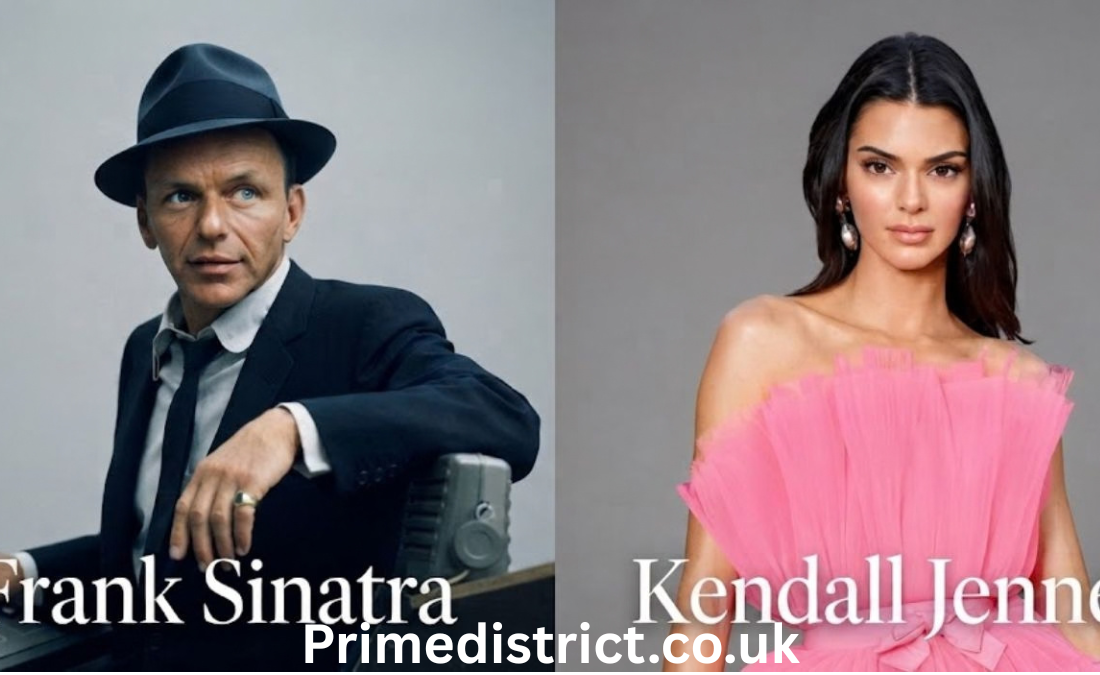
Frank Sinatra and Kendall Jenner represent two very different eras of fame. Sinatra became an iconic singer, actor, and entertainer through records, radio, film, television, and live performance, while Jenner built her public career through reality television, fashion, modeling, and digital media. Although there is no documented family or personal relationship between them, their names became culturally connected through a later advertising campaign that brought Sinatra’s music into a contemporary fashion setting.
Who Was Frank Sinatra?
Frank Sinatra was one of the defining entertainers of 20th-century American popular culture. Born in 1915 in Hoboken, New Jersey, he developed his reputation first as a vocalist before expanding into film, television, and live entertainment. His career demonstrated the value of building a recognizable identity across several forms of media.
Sinatra’s professional environment was very different from today’s digital landscape. Radio broadcasts, record sales, newspapers, cinema, television appearances, and nightclub performances were central to reaching audiences. His success therefore depended on sustained performances and a strong relationship with traditional entertainment institutions.
His influence extended beyond singing. Sinatra became associated with acting, sophisticated stage presentation, fashion, and a distinctive public persona. His career is an example of how a performer could develop a powerful personal brand long before social media existed.
Who Is Kendall Jenner?
Kendall Jenner represents a newer model of celebrity. She first became widely recognized through the Kardashian-Jenner family’s reality television presence and subsequently developed an international career in fashion and modeling.
Unlike Sinatra, Jenner entered an entertainment environment where television was only one part of a much larger media ecosystem. Fashion campaigns, social platforms, digital publications, brand partnerships, and online video can all contribute to a modern celebrity’s reach.
Her career illustrates how public figures can move between industries. Modeling can create opportunities in advertising, fashion, television, and commercial partnerships, allowing a recognizable personal identity to become an important professional asset.
This difference is particularly useful when examining Frank Sinatra and Kendall Jenner together: Sinatra represents the traditional entertainment era, while Jenner reflects the interconnected media environment of the 21st century.
What Connects Frank Sinatra and Kendall Jenner?
The most significant documented connection is cultural rather than personal. Kendall Jenner appeared in a 2017 adidas Originals campaign that used a reworked version of Sinatra’s famous recording “My Way.”
This was not a direct collaboration between Sinatra and Jenner. Sinatra died in 1998, when Jenner was still a young child. The campaign instead used an existing part of Sinatra’s musical legacy in a new creative context.
That distinction is important because online searches can sometimes make unrelated celebrities appear more closely connected than the evidence supports. In this case, the relationship is best understood as a connection between Sinatra’s recorded legacy and Jenner’s participation in modern fashion advertising.
Frank Sinatra and Kendall Jenner Compared
The contrast becomes clearer when their careers are examined side by side.
| Category | Frank Sinatra | Kendall Jenner |
|---|---|---|
| Era | 20th-century entertainment | 21st-century digital and fashion culture |
| Primary fields | Music, film and television | Modeling, fashion and television |
| Main route to fame | Records, radio, performances and cinema | Reality television, modeling and digital media |
| Audience development | Traditional mass media | Television, social media and global digital platforms |
| Brand identity | Singer, actor and entertainer | Model, media personality and fashion figure |
| Major cultural link | Musical catalog and recordings | Modern campaigns using established cultural references |
| Career model | Cross-media entertainment | Cross-industry personal branding |
The table shows that their careers are not particularly similar in structure. Their significance lies instead in what their careers reveal about changing methods of achieving and maintaining public recognition.
How Celebrity Culture Changed Between Their Generations
Sinatra’s career developed when audiences generally encountered entertainers through a limited number of major channels. A successful performer could appear on radio, release records, act in films, perform on stage, and appear on television.
Modern celebrities operate within a more fragmented but interconnected system. A fashion model can simultaneously appear in magazines, runway shows, television programs, social-media content, advertising campaigns, and online publications.
This change also affects the speed of celebrity culture. Traditional entertainers often built recognition gradually through repeated performances and media exposure. Digital platforms can distribute images and campaigns globally almost immediately.
The underlying principle, however, remains familiar: recognizable identity matters. Sinatra cultivated a distinctive artistic and public identity, while Jenner operates in an environment where visual presentation and personal branding are central parts of professional visibility.
The Role of Music in Modern Fashion Marketing
The Sinatra-Jenner connection also demonstrates how older cultural material can gain new relevance through advertising.
A classic recording can carry associations that marketers believe will complement a modern visual campaign. Instead of treating historical music as something limited to its original era, advertisers can reinterpret it for a new audience.
The 2017 adidas Originals campaign provides an example of this approach. Jenner’s presence represented contemporary fashion and celebrity culture, while the reworked Sinatra recording connected the campaign to an established piece of musical history.
For brands, this type of cultural crossover can create a narrative larger than a simple product advertisement. It combines visual identity, music, nostalgia, and contemporary personalities into a single campaign concept.
Personal Branding: A Common Thread
Although Sinatra and Jenner built their careers differently, personal branding provides one useful point of comparison.
Sinatra’s voice, clothing, performances, acting roles, and public image contributed to a recognizable identity. Audiences could associate particular qualities with him even when he moved between music and film.
Jenner’s professional identity similarly extends beyond one role. Her modeling career exists alongside television appearances, fashion campaigns, and other commercial activities.
For businesses, creators, and public figures, the broader lesson is that a personal brand can function like a long-term asset. Consistency can help audiences recognize a person across different platforms and professional opportunities.
What Their Stories Reveal About Media Technology
The technological environment surrounding each celebrity is another major difference.
Sinatra’s audience depended heavily on physical and broadcast media. Records had to be produced and distributed, radio programs had scheduled broadcasts, and films required theatrical or television distribution.
Jenner’s generation operates in a cloud-connected digital environment. Images, videos, campaign materials, and social posts can be distributed across international markets almost instantly.
From a technology perspective, this resembles the evolution from centralized media infrastructure toward scalable digital distribution. A modern fashion campaign can use cloud storage, content-delivery networks, analytics platforms, automated publishing systems, and social-media distribution to reach audiences around the world.
The underlying objective is similar to traditional entertainment: deliver content reliably to a large audience. The infrastructure, however, has changed dramatically.
Challenges of Maintaining a Celebrity Legacy
Longevity presents different challenges for different generations.
For Sinatra, maintaining relevance depended on recordings, films, archival releases, radio programming, television exposure, and continued public interest. His existing work could be preserved and introduced to new audiences.
Modern celebrities face a different challenge: constant visibility. Digital audiences receive enormous amounts of content, meaning public attention can change rapidly. Maintaining a recognizable identity requires adaptation without completely abandoning an established image.
For brands, this creates a balancing act between heritage and innovation. Older cultural properties provide familiarity, while contemporary personalities can help introduce those properties to newer audiences.
The Sinatra-Jenner connection demonstrates this principle clearly: an established musical identity can be placed inside a modern visual campaign without requiring the original performer to participate.
Future Trends in Celebrity and Entertainment
The relationship between entertainment, fashion, technology, and advertising is likely to become even more interconnected.
Digital archives will continue making historical performances accessible to new audiences. Streaming platforms can introduce classic music and films to people who were born decades after their original release. Fashion companies can also continue combining established cultural references with contemporary personalities.
At the same time, social media and digital advertising will make personal branding increasingly measurable. Companies can evaluate campaign engagement, audience demographics, content performance, and international reach much more quickly than traditional media allowed.
For beginners studying media or marketing, the important takeaway is that celebrity culture is not simply about fame. It is also about distribution, storytelling, audience relationships, intellectual property, branding, and technology.
Frequently Asked Questions
Are Frank Sinatra and Kendall Jenner related?
There is no documented family relationship between Frank Sinatra and Kendall Jenner. Their established family histories are separate.
Did Frank Sinatra and Kendall Jenner work together?
No. There is no documented direct professional collaboration between them. The connection comes from a later adidas Originals campaign featuring Jenner that used a reworked version of Sinatra’s “My Way.”
Did Kendall Jenner meet Frank Sinatra?
There is no reliable public documentation establishing that the two had a notable personal meeting. Jenner was born in 1995, while Sinatra died in 1998.
Why are Frank Sinatra and Kendall Jenner mentioned together?
Their names are primarily connected through the 2017 adidas Originals “Original Is Never Finished” campaign, which featured Jenner and used a reworked version of Sinatra’s “My Way.”
What can their careers teach us about celebrity culture?
Their careers demonstrate how the methods of building public recognition have changed. Sinatra relied heavily on music, radio, film, television, and live performance, while Jenner’s career developed through reality television, fashion, modeling, advertising, and digital media.
Conclusion
Frank Sinatra and Kendall Jenner belong to different generations, industries, and media environments, yet their names became connected through an interesting piece of modern popular culture. Sinatra established a remarkable legacy through music, acting, and traditional entertainment, while Jenner developed a contemporary career spanning television, modeling, fashion, and digital celebrity culture.
The documented connection between them is not a family relationship or direct collaboration. Instead, it is the later use of Sinatra’s music in an adidas Originals campaign featuring Jenner.
Their story ultimately illustrates how cultural influence can cross generations. A recording created decades ago can become part of a modern advertising campaign, while a contemporary fashion figure can help place a classic cultural reference in front of a new audience. That ability to connect heritage with modern media is one of the most interesting features of today’s entertainment and marketing landscape.