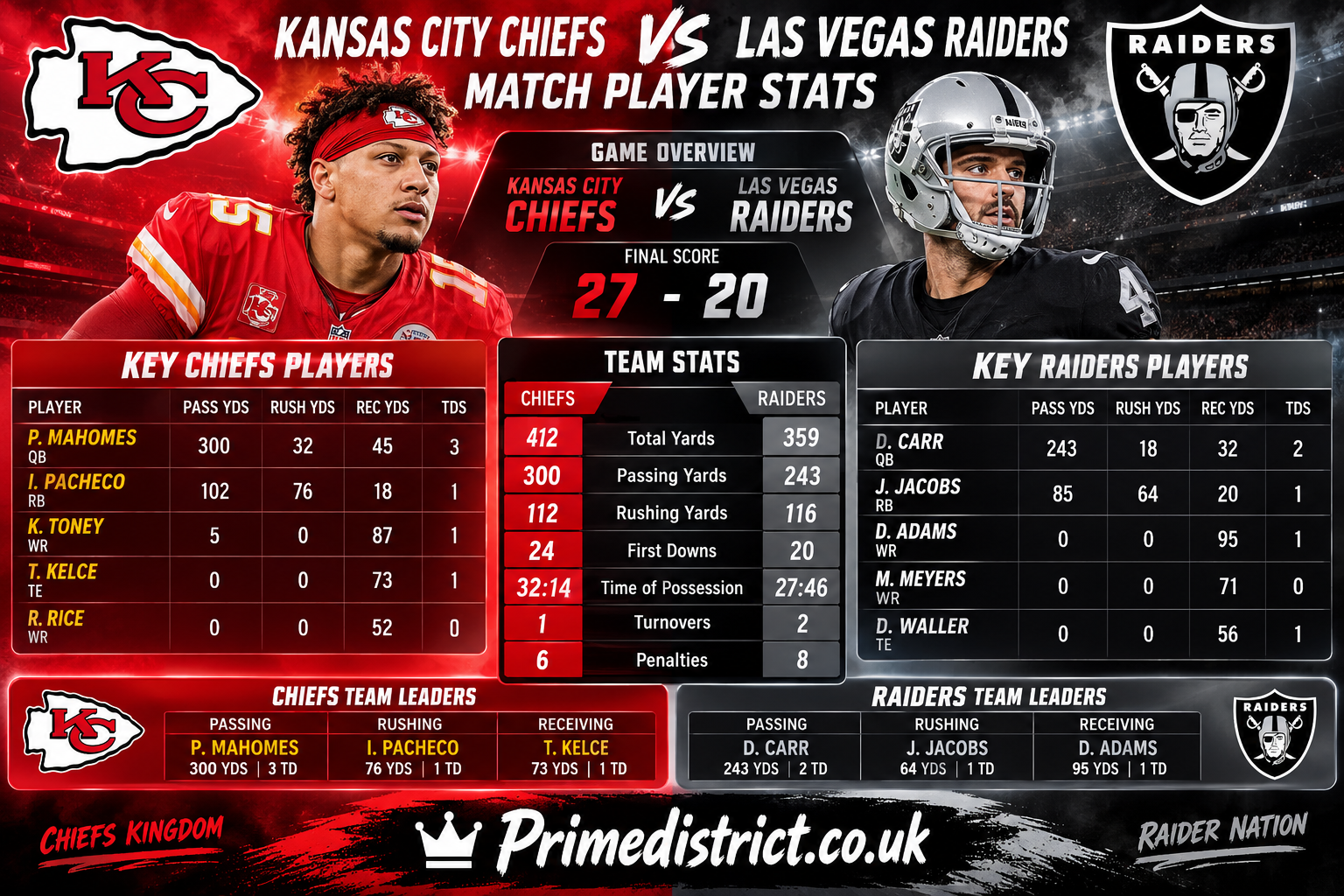
The Kansas City Chiefs defeated the Las Vegas Raiders 30–27 on October 4, 2026, in a closely contested AFC West matchup at Allegiant Stadium. Kenneth Walker III delivered a standout rushing performance, while Patrick Mahomes connected with Tyquan Thornton for two touchdowns. Despite producing more total yards, Las Vegas could not turn its offensive advantage into a victory.
Kansas City Chiefs vs Las Vegas Raiders: Match Overview
The Week 4 meeting between Kansas City and Las Vegas produced a game of contrasting strengths. The Chiefs relied on explosive running plays and timely scoring, while the Raiders used their passing attack and extended possessions to remain competitive.
According to the published box score, Kansas City finished with 399 total net yards, compared with 437 for Las Vegas. The Raiders also controlled possession for 35 minutes and 42 seconds, considerably longer than the Chiefs’ 24 minutes and 18 seconds. However, the final scoreboard favored Kansas City, which scored 20 fourth-quarter points to secure the win.
The game was tied 7–7 after the opening quarter. Las Vegas then took a 13–10 halftime lead after adding two field goals in the second quarter. Neither team scored in the third quarter, setting up a decisive finish in which Kansas City found the end zone twice in quick succession.
Key Player Stats: Chiefs vs Raiders
The following figures summarize the principal offensive performances from the October 4 game.
| Player | Passing Stats | Rushing Stats | Receiving Stats |
|---|---|---|---|
| Patrick Mahomes, Chiefs | 15/30, 225 yards, 2 TD | 2 carries, 0 yards | — |
| Kenneth Walker III, Chiefs | — | 22 carries, 177 yards, 2 TD | 1 catch, 2 yards |
| Tyquan Thornton, Chiefs | — | — | 5 catches, 111 yards, 2 TD |
| Kirk Cousins, Raiders | 31/52, 365 yards, 2 TD, 1 INT | — | — |
| Ashton Jeanty, Raiders | — | 15 carries, 58 yards | 6 catches, 68 yards |
| Brock Bowers, Raiders | — | — | 6 catches, 86 yards, 1 TD |
TD means touchdown; INT means interception. Statistics are from the published game box score.
Kenneth Walker III Becomes the Chiefs’ Biggest Offensive Threat
Kenneth Walker III was the leading individual performer for Kansas City. The running back finished with 177 rushing yards on 22 carries and two touchdowns, giving the Chiefs a powerful ground attack when the game was on the line.
His longest run covered 76 yards, a burst that moved Kansas City deep into Raiders territory. The play demonstrated how quickly the Chiefs could change the game’s momentum without needing a long series of short passes.
Walker scored his first rushing touchdown from two yards out. Shortly afterward, he added a 22-yard touchdown run, helping Kansas City build a more comfortable lead.
The two touchdowns came within 19 seconds of each other. A Las Vegas fumble on the ensuing kickoff gave the Chiefs another opportunity, and Walker capitalized. That short stretch became one of the defining sequences of the contest.
Walker’s performance mattered because Kansas City had struggled to generate much offense in the third quarter. His explosive running restored the Chiefs’ momentum and helped them overcome a deficit in the final period.
Patrick Mahomes Delivers Two Touchdown Passes
Patrick Mahomes completed 15 of 30 passes for 225 yards and two touchdowns. He did not throw an interception, although Las Vegas applied pressure throughout the game.
The quarterback’s numbers were not especially high in terms of completion percentage, but the timing of his connections with Thornton proved important. Both of Mahomes’ passing touchdowns went to the same receiver, providing Kansas City with a productive alternative to its running game.
Mahomes also helped create the field position that led to Walker’s scoring opportunities. His ability to attack downfield prevented the Raiders from focusing entirely on stopping the run.
The game illustrated an important point about quarterback statistics: passing yards alone do not explain the result. Mahomes finished with fewer passing yards than Cousins, but Kansas City’s rushing production and late-game execution made the difference.
Tyquan Thornton’s Career Day Ends With an Injury
Tyquan Thornton was Mahomes’ most productive receiving target in the matchup. He recorded five receptions for 111 yards and two touchdowns, including a significant 55-yard catch during the fourth quarter.
That reception helped put Kansas City in position to score. Thornton had found separation downfield, creating the opening for Mahomes to deliver one of the game’s most consequential passes.
However, the performance ended on a concerning note. Reuters reported that Thornton injured his left ankle on the long reception and was taken off the field on a cart.
The injury was a major development alongside his two-touchdown performance. The game statistics establish his production that day, but they do not independently establish his subsequent recovery timeline or availability for later games.
Kirk Cousins Keeps the Raiders in the Contest
For Las Vegas, quarterback Kirk Cousins produced substantial passing numbers. He completed 31 of 52 attempts for 365 yards and two touchdowns, with one interception.
Cousins repeatedly moved the Raiders downfield, helping explain why Las Vegas finished with more total net yards and held possession for longer. His passing output was particularly notable because the Raiders remained within striking distance throughout the second half.
His first touchdown pass went to Ian Thomas for 27 yards. Late in the fourth quarter, Cousins found tight end Brock Bowers for a 20-yard touchdown that brought the Raiders closer to Kansas City.
Cousins then connected with Cody White on a two-point conversion. The play cut Kansas City’s advantage to three points and gave Las Vegas a late opportunity to challenge the result.
However, the Raiders could not complete the comeback. Kansas City’s defense made the critical stops needed to protect the lead, and safety Xavier Nwankpa recorded the interception that sealed the Chiefs’ victory.
Brock Bowers and Ashton Jeanty Provide Important Support
Brock Bowers was one of the Raiders’ key receiving options. He finished with six receptions for 86 yards and a touchdown, including the late scoring play that kept the game competitive.
His fourth-quarter touchdown showed how effectively Las Vegas could use its tight end in important passing situations. The subsequent two-point conversion briefly brought the Raiders within a field goal of tying the game.
Running back Ashton Jeanty also contributed in two phases. He recorded 58 rushing yards on 15 carries and added six receptions for 68 yards.
Jeanty’s combined rushing and receiving production gave Cousins another outlet beyond the Raiders’ primary wide receivers. Yet the overall offensive output was not enough to overcome the Chiefs’ crucial late-game plays.
Why Kansas City Won Despite Having Fewer Total Yards
The team statistics reveal the central story of the matchup. Las Vegas gained more total net yards and held the ball for longer, but Kansas City converted its most important opportunities into touchdowns.
The Chiefs’ fourth-quarter surge included Walker’s two rushing scores, while the Raiders’ costly kickoff fumble helped Kansas City regain control. Nwankpa’s late interception then prevented Las Vegas from completing its final attempt to change the outcome.
Kansas City’s scoring distribution also proved decisive. After managing only a field goal in the second quarter and no points in the third, the Chiefs scored 20 points in the fourth. The Raiders scored 14 in that same period, leaving them three points short.
Veteran tight end Travis Kelce also reached a career milestone during the game. Reuters reported that he finished with 1,096 career receptions, moving into seventh place on the NFL’s all-time receptions list and passing former Raiders receiver Tim Brown.
Final Verdict: What the Player Stats Reveal
The Kansas City Chiefs vs Las Vegas Raiders match player stats tell a clear story. Kenneth Walker III led the Chiefs with 177 rushing yards and two touchdowns, while Patrick Mahomes threw for 225 yards and two scores. Tyquan Thornton added 111 receiving yards and two touchdowns before leaving with an injury.
For Las Vegas, Kirk Cousins threw for 365 yards and two touchdowns, while Brock Bowers contributed 86 receiving yards and a score. The Raiders gained more total net yards, but a costly fumble and Kansas City’s decisive fourth-quarter execution shaped the result.
The final answer is straightforward: Kansas City won 30–27 because its biggest plays came at the most important moments. The individual numbers explain the performances, while the timing of the touchdowns and the late defensive stop explain the result.