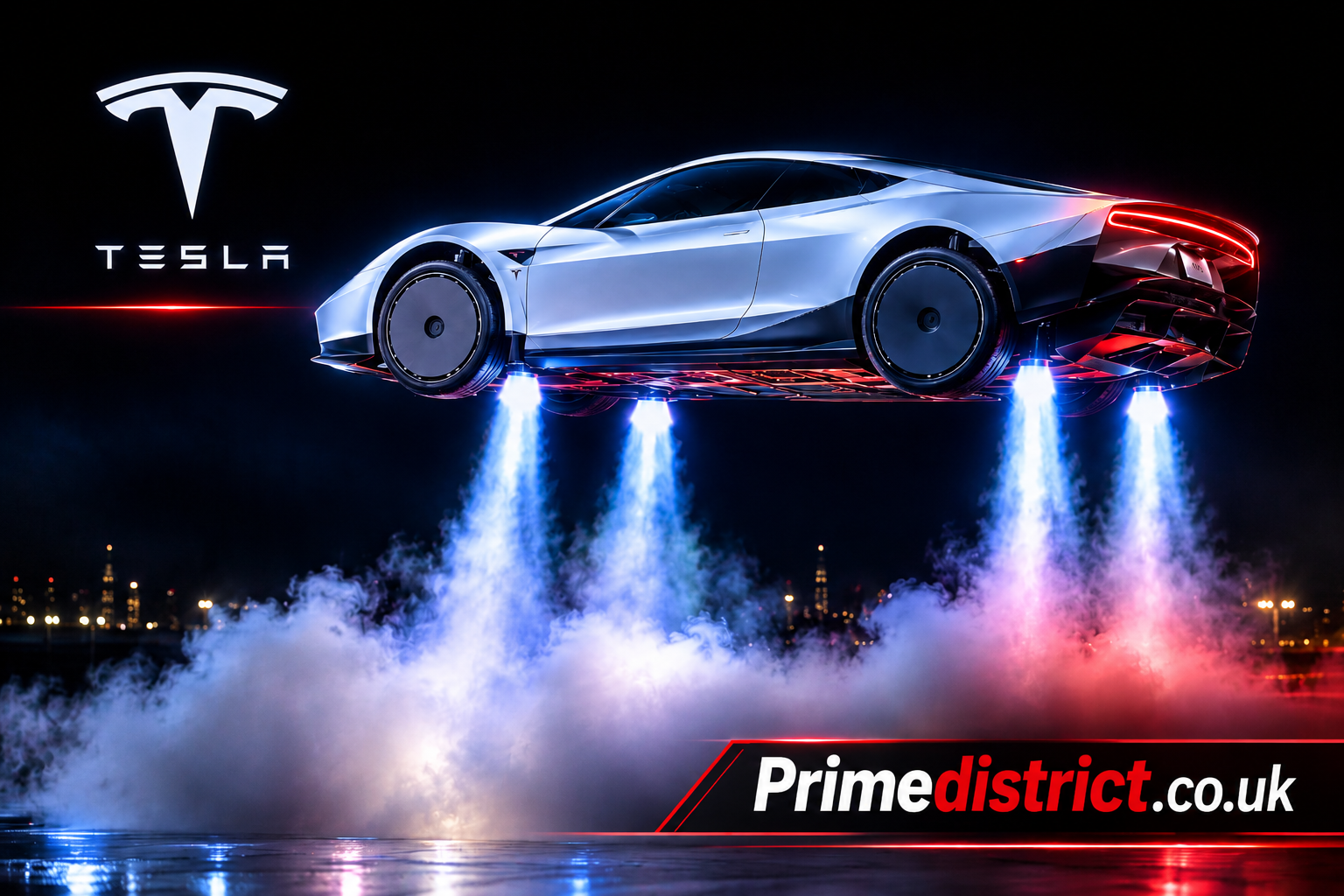
What Is a Tesla Flying Car?
A Tesla flying car generally refers to a hypothetical vehicle that combines the convenience of an electric car with the ability to fly. People searching for the term often want to know whether Tesla has announced such a vehicle, how much it might cost, and when it could reach the market.
However, a Tesla-branded flying car has not been officially established as a production vehicle. Tesla is known for its electric cars, battery technology, and charging infrastructure, but a road-going vehicle that can also fly would require different engineering, safety systems, and regulatory approvals.
The term can also refer to electric vertical takeoff and landing aircraft, commonly called eVTOLs. These aircraft are being developed by other companies and are designed to take off and land vertically without a conventional runway. They are not automatically flying cars, and they are not Tesla products.
Has Tesla Officially Announced a Flying Car?
As of October 2026, there is no confirmed Tesla flying-car production model with an established release date, official retail price, or published customer delivery schedule.
Elon Musk has discussed futuristic transportation concepts over the years, including ideas involving electric aircraft and high-speed travel. However, discussing a possible technology is different from announcing a finished product that customers can order.
That distinction matters because online videos, speculative concept designs, and social media posts sometimes present imagined Tesla vehicles as if they were official announcements.
No confirmed launch date or production specifications should be treated as fact unless Tesla formally announces them.
Tesla Roadster and the Flying Car Connection
The subject changed significantly in October 2026 when Tesla presented a redesigned version of its next-generation Roadster with rocket-style thrusters. The demonstration showed the vehicle performing a brief airborne maneuver, bringing the idea of a flying Tesla closer to a real engineering experiment than a purely imagined concept. However, this does not make the Roadster a conventional aircraft.
The distinction is important: brief airborne movement is not the same as sustained, controlled flight. A car that lifts off momentarily cannot automatically travel long distances through the air, carry passengers safely as an aircraft, or operate in ordinary airspace.
The redesigned Roadster is expected to enter production in 2028, although future production and delivery dates can change. Its demonstration should not be confused with the launch of a fully functional flying car for everyday transportation.
How Could Rocket Thrusters Help a Car Fly?
Rocket-style thrusters can produce force by expelling gas at high speed. When arranged and controlled properly, they can influence a vehicle’s movement, including lifting it or changing its position briefly.
For a road car, however, this approach creates substantial engineering challenges. The vehicle must manage thrust, balance, braking, energy use, and the forces acting on its structure. Even a successful demonstration would not establish that the technology is practical for routine travel.
Tesla’s Roadster is primarily a high-performance electric sports car, not a certified aircraft designed for regular journeys through the sky.
Why Are People Interested in a Tesla Flying Car?
The excitement comes from the possibility of combining two types of transportation. Electric cars have already changed how many people think about driving, while advances in aircraft design have encouraged companies to explore new ways of moving people through crowded cities.
A flying vehicle could theoretically reduce dependence on roads for some journeys. Imagine traveling between two busy urban areas without following the same traffic routes as conventional cars.
Yet several questions remain unanswered. How far could the vehicle travel through the air? How many passengers could it carry? Would it require special landing areas? And would the price make it accessible to ordinary drivers?
Until these questions are addressed with demonstrated capabilities and official specifications, the practical future of a Tesla flying car remains uncertain.
What Would a Tesla Flying Car Cost?
There is no confirmed retail price for a Tesla vehicle designed and approved for conventional flight. The price of the Roadster cannot be treated as the price of a future flying car because the two concepts have different capabilities and requirements.
A genuine flying vehicle would need specialized hardware, additional safety systems, and potentially expensive maintenance. Depending on its design, it might also require insurance and training beyond what is necessary to drive a regular car.
The total cost of ownership would matter as much as the initial purchase price. Buyers would need to consider charging or propulsion systems, inspections, repairs, insurance, and any required pilot certification.
For now, any online estimate for a Tesla flying car should be treated as speculation unless it is supported by an official product announcement.
When Could a Tesla Flying Car Be Available?
The redesigned Roadster is expected to enter production in 2028, but its rocket-assisted demonstration does not establish when a certified flying vehicle could become available to consumers.
Several milestones would need to be achieved before a practical flying car could become part of everyday transportation.
-
Engineering development: The vehicle would need reliable propulsion, stability, and control systems for its intended flight capabilities.
-
Safety testing: Engineers would need to demonstrate safe performance under different operating conditions.
-
Regulatory approval: Any aircraft functionality intended for public use would need to meet the applicable aviation requirements, alongside relevant road-vehicle rules.
-
Production readiness: The manufacturer would need to demonstrate that the vehicle can be built, maintained, and operated reliably.
These steps take time, and a successful prototype does not guarantee a commercially available product. Therefore, there is currently no reliable date for the arrival of a Tesla flying car designed for everyday flight.
Could a Tesla Flying Car Be Used on Public Roads?
A vehicle that can move through the air would not automatically be legal to operate on public roads. Its road-driving capabilities would need to meet applicable vehicle safety standards, while its flight capabilities would raise separate aviation requirements.
The exact rules would depend on the vehicle’s design and intended use. A car capable of a brief airborne stunt, for example, is different from an aircraft designed to transport passengers between cities.
Manufacturers would also need to consider where the vehicle could take off and land, how it would interact with other aircraft, and what training operators might require.
For American consumers, regulatory approval and practical safety will be just as important as the technology itself.
Tesla Flying Car vs. a Traditional Flying Car
| Feature | Tesla Roadster with thrusters | Conventional flying car concept |
|---|---|---|
| Primary purpose | High-performance road driving | Road travel and flight |
| Airborne capability | Demonstrated brief airborne movement | Depends on the specific design |
| Sustained flight | Not established as a passenger aircraft | Must be demonstrated by the aircraft |
| Public flight approval | Not established | Depends on the model and certification |
| Confirmed everyday flying-car release | Not announced | Varies by manufacturer |
The comparison highlights why the term flying car needs careful interpretation. Not every vehicle that leaves the ground is designed to function as an aircraft.
Frequently Asked Questions
1. Is the Tesla flying car real?
Tesla has demonstrated a redesigned Roadster performing a brief airborne maneuver using rocket-style thrusters. However, a road vehicle capable of that maneuver is not the same as a certified flying car for everyday transportation.
2. What is the Tesla flying car called?
The vehicle associated with the recent airborne demonstration is the next-generation Tesla Roadster. It is a high-performance electric sports car with demonstrated thruster-assisted movement, not a separately established passenger aircraft.
3. How much will the Tesla flying car cost?
There is no confirmed retail price for a Tesla flying car designed for regular flight. Any price estimate for such a vehicle remains speculative unless supported by official specifications and pricing information.
4. When will the Tesla flying car be released?
The redesigned Roadster is expected to enter production in 2028. However, that expectation does not establish a release date for a fully functional, aviation-approved Tesla flying car.
5. Can the Tesla Roadster fly like an airplane?
The demonstrated Roadster can perform a brief airborne maneuver, but sustained flight like an airplane has not been established. Its demonstrated capability should not be interpreted as proof that it can carry passengers through the air on ordinary journeys.
Conclusion
The Tesla flying car concept has attracted attention because it combines the excitement of electric vehicles with the possibility of airborne transportation. Tesla’s thruster-equipped Roadster demonstration represents a more tangible development than a speculative concept drawing, but it does not establish a practical flying car for everyday use. Until sustained flight capability, safety requirements, regulatory approval, pricing, and availability are confirmed, consumers should distinguish demonstrated technology from future possibilities.