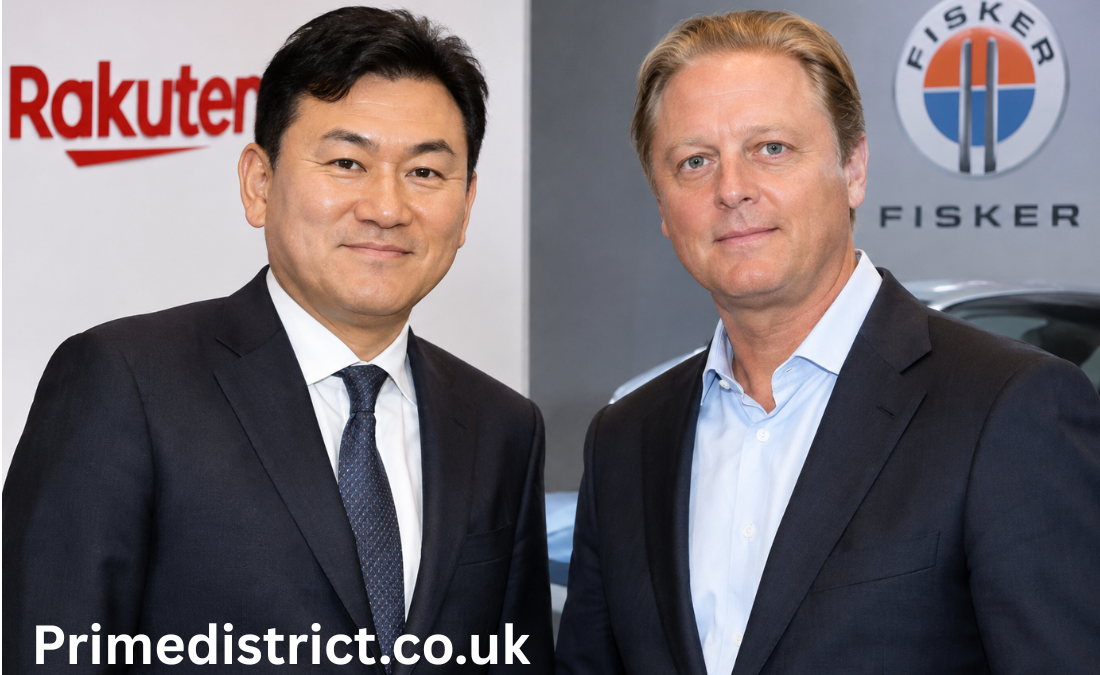
Hiroshi Mikitani and Henrik Fisker are two entrepreneurs whose careers have developed in very different industries. Mikitani built Rakuten into a broad technology ecosystem spanning commerce, fintech, communications, and digital services, while Fisker became internationally known for automotive design and electric-vehicle ventures. Their names may appear together in online searches, but the stronger story is the contrast between their approaches to innovation, scale, product creation, and business growth.
Who Is Hiroshi Mikitani?
Hiroshi Mikitani is the founder, chairman, and CEO of Rakuten Group. He established Rakuten in Japan in 1997 after beginning his career in investment banking and earning an MBA from Harvard Business School. The company developed from an online marketplace into a much wider digital ecosystem covering areas including e-commerce, financial technology, digital content, and communications.
Mikitani’s career demonstrates the value of building around a connected platform rather than depending on a single product. Rakuten has expanded into different services while maintaining a recognizable corporate ecosystem. That approach has similarities to a well-designed cloud platform, where multiple applications can share identity, data, networking, and other common infrastructure.
His leadership has also extended beyond Rakuten’s original marketplace business. He has held leadership positions connected with Rakuten Mobile, Rakuten Symphony, Rakuten Medical, professional sports, and other organizations, reflecting a broad entrepreneurial portfolio.
Who Is Henrik Fisker?
Henrik Fisker is a Danish automotive designer and entrepreneur whose career has centered on vehicle design, luxury automobiles, and new mobility concepts. His professional history includes work associated with BMW and Aston Martin, and his designs include the BMW Z8 and Aston Martin V8 Vantage and DB9. He also designed the Fisker Karma, an electrified performance vehicle that reached production in 2011.
Fisker’s career later moved beyond design into company building. He co-founded Fisker Automotive and subsequently co-founded Fisker Inc. in 2016 with Geeta Gupta-Fisker. The latter company developed the Fisker Ocean electric SUV but entered Chapter 11 bankruptcy proceedings in the United States in June 2024.
His story therefore combines creative achievement with the difficult realities of automobile manufacturing, financing, supply chains, engineering, regulatory requirements, and scaling production.

Is There a Direct Connection Between Hiroshi Mikitani and Henrik Fisker?
There is no prominent direct personal or business relationship between Hiroshi Mikitani and Henrik Fisker established in the official biographies and corporate information reviewed for this topic. Their careers are documented largely as separate stories.
That distinction matters because names appearing together online do not automatically indicate a partnership, investment, friendship, or corporate transaction. Mikitani is primarily associated with Rakuten and technology entrepreneurship, whereas Fisker is associated with automotive design and electric-vehicle ventures.
The more useful comparison is therefore entrepreneurial rather than personal. Both men have worked around innovation, international markets, ambitious products, and large-scale business challenges. Yet the systems required to execute their visions are remarkably different.
Two Different Models of Innovation
Mikitani’s model is strongly associated with creating an ecosystem in which different services can reinforce one another. Rakuten’s businesses operate across several digital sectors, allowing the company to develop a broad network of users and services.
Fisker’s model has historically been much more product-centered. Automotive design begins with a physical object that must eventually be engineered, manufactured, tested, distributed, serviced, and supported. A beautiful design is only one part of the final product.
This distinction resembles the difference between a software platform and a hardware production environment. In cloud architecture, software services can often scale through additional computing capacity. A vehicle manufacturer cannot simply create another production line with a few configuration changes. Factories, suppliers, tooling, logistics, certification, and skilled labor must all scale together.
What Their Careers Teach About Scalability
Scalability is one of the most important challenges in modern business. Rakuten’s development shows how a company can gradually add services to an existing digital ecosystem. A technology platform can use shared infrastructure and common customer relationships to support expansion into new markets.
In cloud architecture, a similar concept is called horizontal scalability. Instead of making one server endlessly larger, an organization can distribute workloads across multiple resources. This provides flexibility when demand increases.
Automotive businesses face a more physical form of scalability. EV production requires batteries, components, factories, suppliers, software, vehicle electronics, distribution networks, and after-sales support. Fisker Inc.’s difficulties show why scaling an innovative product requires much more than attracting consumer interest. Fisker Inc. entered Chapter 11 proceedings in June 2024, illustrating the financial and operational pressures that can affect a young vehicle manufacturer.
Security and Reliability in Technology-Driven Companies
Security is another area where modern businesses can learn from technology architecture. A growing digital ecosystem needs protection across applications, identities, databases, payment systems, and communication channels.
A strong cloud design usually follows a layered security approach. Customer identity should be protected independently from application services, sensitive information should be encrypted, and access should follow the principle of least privilege.
A physical product company has a different security environment. Connected vehicles may contain software, sensors, wireless communications, and user data. Security must therefore extend from vehicle components to mobile applications and backend systems.
The important lesson is that innovation should not be separated from reliability. Whether a company sells digital services or advanced vehicles, customers expect the underlying system to work consistently.
Cost Management and Business Infrastructure
Cost management becomes more important as an ambitious company grows. For a technology business, infrastructure costs may include cloud computing, storage, networking, software development, cybersecurity, data processing, and customer support.
Cloud architecture allows businesses to match infrastructure spending more closely with demand. For example, an online platform experiencing a sudden seasonal traffic increase can automatically add computing resources and reduce them later. This can be more flexible than maintaining permanent excess capacity.
Manufacturing companies face different cost structures. Automotive production requires factories, equipment, employees, engineering programs, inventory, logistics, supplier contracts, and warranty operations. The financial commitment exists well before every vehicle generates revenue.
This contrast helps explain why product innovation and business scalability must be considered together.
A Practical Comparison of Their Careers
The careers of Hiroshi Mikitani and Henrik Fisker illustrate different forms of entrepreneurship.
| Area | Hiroshi Mikitani | Henrik Fisker |
|---|---|---|
| Primary industry | Technology and digital services | Automotive design and mobility |
| Best known for | Founding and expanding Rakuten | Automotive design and EV ventures |
| Business model | Diversified digital ecosystem | Product and vehicle development |
| Innovation focus | Platforms, services, connectivity | Design, mobility, electrification |
| Major challenge | Managing a broad ecosystem | Scaling vehicle development and production |
| Architecture lesson | Modular platform expansion | Coordinated hardware and software systems |
| Current professional profile | Rakuten founder, chairman and CEO | Automotive designer, entrepreneur and adviser |
The comparison should not be interpreted as evidence that one model is universally superior. Each operates under different market conditions and requires different resources, risk management, and technical infrastructure.
What Happens When Innovation Meets Real-World Constraints?
One of the biggest lessons from Fisker’s career is that innovation must eventually meet operational reality. An attractive vehicle concept can generate excitement, but production requires dependable suppliers, financing, manufacturing capacity, software reliability, regulatory compliance, and customer support.
The same principle applies to cloud systems. A prototype may work perfectly for a small number of users, but a production platform needs monitoring, redundancy, backups, incident response, security controls, and disaster recovery.
Fisker Inc.’s 2024 bankruptcy proceedings provide a documented example of how financial and operational pressures can undermine a technology-heavy product business. Magna International, which had worked with Fisker on the Ocean program, later reported that its Fisker manufacturing agreement was terminated during the bankruptcy proceedings.
For entrepreneurs, the broader lesson is straightforward: innovation creates possibilities, but execution determines whether those possibilities become sustainable businesses.
Future Trends in Technology, Mobility, and Entrepreneurship
The boundary between technology and traditional industries continues to shrink. Cars increasingly resemble connected computing platforms, while technology companies increasingly manage physical infrastructure and global logistics.
This convergence makes cloud architecture particularly important. Connected vehicles, digital marketplaces, financial applications, and mobile services can all depend on distributed computing, APIs, real-time data, analytics, and secure identity systems.
Future entrepreneurs may therefore need to understand both product design and digital infrastructure. The strongest systems will likely combine modular software, intelligent automation, cybersecurity, scalable data platforms, and efficient physical operations.
Mikitani’s long-term technology ecosystem and Fisker’s emphasis on design and mobility represent different sides of this broader transformation. One begins with interconnected digital services; the other begins with a physical product enhanced by software and electrification.
Frequently Asked Questions
Are Hiroshi Mikitani and Henrik Fisker business partners?
No prominent direct partnership between Hiroshi Mikitani and Henrik Fisker is established in the corporate and biographical sources reviewed. Their careers are primarily associated with separate industries and companies.
What is Hiroshi Mikitani best known for?
Hiroshi Mikitani is best known for founding Rakuten in 1997 and leading its expansion into a diversified technology group with businesses across e-commerce, fintech, digital content, and communications.
What is Henrik Fisker known for?
Henrik Fisker is best known as an automotive designer and entrepreneur. His design portfolio includes vehicles associated with BMW and Aston Martin, as well as the Fisker Karma and Fisker Ocean.
What happened to Fisker Inc.?
Fisker Inc. and its U.S. subsidiaries entered voluntary Chapter 11 bankruptcy proceedings in June 2024. The proceedings followed substantial financial and operational difficulties surrounding the company’s EV business.
Why are Hiroshi Mikitani and Henrik Fisker discussed together?
Their names can be treated as a comparison of two different entrepreneurial approaches. Mikitani built a diversified technology ecosystem, while Fisker developed a career around automotive design and electric mobility. There is not enough documented evidence to treat their shared appearance in a search as proof of a direct relationship.
Conclusion
Hiroshi Mikitani and Henrik Fisker represent two very different paths through modern entrepreneurship. Mikitani built Rakuten from a Japanese online marketplace into a broad technology ecosystem, while Fisker moved from world-class automotive design into the challenging business of creating electric-vehicle companies.
Their stories demonstrate that innovation has many forms. Digital platforms can scale through software and shared infrastructure, while automotive innovation must coordinate design, engineering, manufacturing, finance, logistics, and technology. For today’s entrepreneurs, the lasting lesson is that a strong idea is only the starting point. Sustainable growth depends on architecture, execution, security, cost control, and the ability to scale without losing reliability.